Ask a warehouse manager what worries them most and you’ll hear about late trucks, staff shortages, damaged stock. Fire usually comes up last, if at all. Then one bad night changes that, and everyone suddenly has opinions about sprinklers.
I’d rather you have those opinions now. So let’s talk about what warehouse fire safety services actually are, what they cost you if you skip them, and how to hire someone who knows what they’re doing.
So, what do these services actually cover?
In plain terms, warehouse fire safety services are the people and systems that stop a fire from starting, spot it quickly if it does, and keep it small until help arrives. That usually means a risk assessment, alarms and detectors, sprinklers, extinguishers, staff training, paperwork like the fire NOC, and regular maintenance.
The key word is system. Six extinguishers hung on a wall isn’t a fire plan. It’s decoration with a red finish.
Why warehouses burn so badly
Picture the inside of a typical warehouse. Cardboard everywhere. Plastic wrap, wooden pallets, foam packing, maybe some chemicals in a corner nobody likes to talk about. All of it stacked ten or twelve metres high, with gaps between the racks that work like chimneys.
Once a fire gets into that racking, it climbs fast. Heat gathers under the roof and pushes down again. Smoke spreads across the open floor long before you see flames. And if it starts at 2 a.m. in a section nobody’s working in, it can run for a good while before anyone notices.
Add battery chargers, old wiring and a forklift that’s been “fine” for years, and you can see why warehouse fire safety services aren’t a luxury. They’re basic protection for a building built to burn.
What a proper provider will do for you
A good company doesn’t show up, sell you a few cylinders and leave. Here’s how the work usually goes.
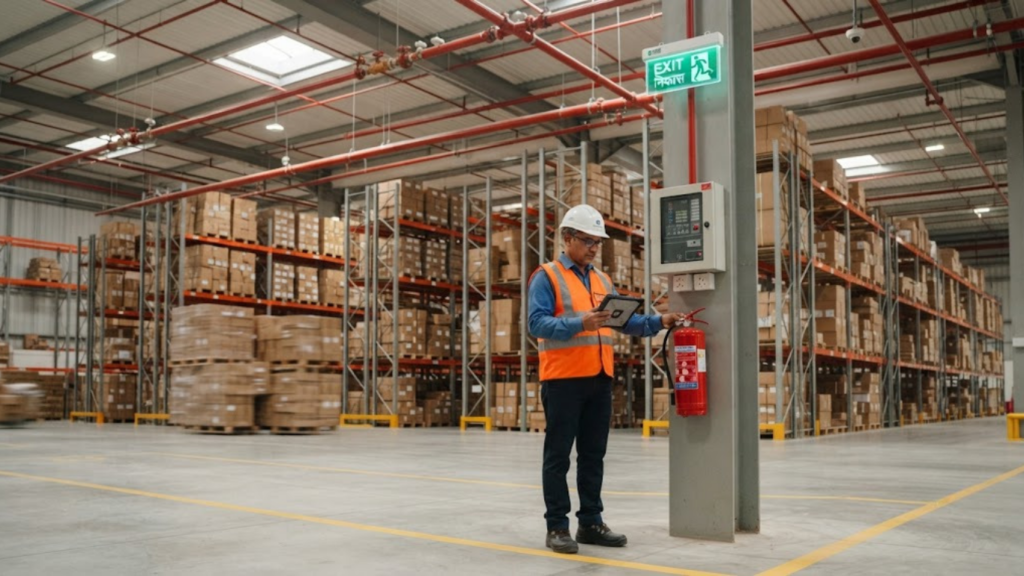
They start by walking the site. A real fire risk assessment means someone looks at your racking, your electrical load, your exits, your charging area, the way your team actually works. You get a written list of problems, ranked by how dangerous they are. If a provider quotes you without visiting, be suspicious.
Then they fix detection. Smoke detectors are fine for small rooms, but high ceilings often need beam detectors or heat sensors. Addressable panels are worth the money because they tell you where the trouble is, not just that there’s some.
Then comes suppression. Sprinklers do most of the heavy lifting in a warehouse. Tall storage often needs ESFR sprinklers, which are designed to hit a fire hard and early. Server rooms or chemical stores may need gas or foam systems instead. Water on the wrong fire can make things worse, so this isn’t a place for guesswork.
Extinguishers, hydrants and hose reels come next. Paper fires, electrical fires and oil fires need different tools. The right extinguisher in the wrong place, say behind a stack of pallets, is useless.
Compliance is the boring part that matters. In India, most warehouses need to follow the fire and life safety rules in the National Building Code 2016 and get a fire NOC from the local authority. Rules shift from state to state and depend on your building size and what you store, so always confirm with your local fire department. A decent provider will handle drawings, inspections and paperwork so you’re not running between offices for weeks.
Training is where many owners cut corners. Equipment doesn’t fight fires on its own. Somebody has to raise the alarm, somebody has to call the fire brigade, and everyone has to know which way to run. Drills feel silly right up until the day they don’t.
And finally, maintenance. A sprinkler valve someone closed “temporarily” last year. An extinguisher with an expired seal. These things sit there looking fine while quietly doing nothing. An annual maintenance contract keeps the whole setup honest, and standards like NFPA 25 give a solid reference for how often water-based systems should be tested.
The mistakes I’d bet you’re making
Not you specifically, but most warehouses. These come up again and again.
Stock piled in front of exits and extinguishers. It happens during peak season, gets “fixed later,” and never does.
Racking that changed but sprinklers that didn’t. If you’ve added a tier or moved things around, your coverage might not match your storage anymore.
Systems installed years ago and never checked again. They don’t announce when they’ve stopped working.
Extension boards daisy-chained across the floor, plus cheap chargers plugged in all night. Electrical faults cause a big share of warehouse fires, and most are avoidable.
Training everyone once and forgetting about it. Warehouses have high staff turnover. Your fire plan is only as good as your newest hire’s understanding of it.
Don’t ignore the lithium-ion problem
More warehouses now run electric forklifts and pallet trucks, which means lithium-ion batteries are being charged inside the building. When one of these overheats, it can go into thermal runaway, and it’s stubborn to put out.
Keep charging in a separate, ventilated area with proper fire separation. Use the charger that came with the battery, not a cheaper lookalike. Don’t leave things charging overnight with nobody watching. And ask any provider you’re considering whether they understand battery risks. If you get a blank look, move on.
How to pick a provider you can trust
Choosing warehouse fire safety services shouldn’t come down to the lowest quote. Ask these questions before you sign anything.
Have they worked on warehouses before, or only offices and shops? High-rack storage is a different game. Are their engineers licensed, and does the equipment carry recognised approvals like ISI, UL or FM? Will they handle design, installation, testing, paperwork and maintenance, or will you be juggling four vendors? Do you get written inspection reports, not just a phone call saying everything’s fine? What happens when an alarm fails at night? And can you speak to two or three past warehouse clients?
A good company enjoys these questions. A shaky one gets defensive.
Is it worth the money?
It’s fair to wince at the cost. Fire protection is a real expense, and nothing visibly “happens” when it works.
But compare it to the other side. Lost inventory. Weeks of stopped operations. Customers who go elsewhere. Legal trouble if someone gets hurt. Insurance disputes. Some insurers also look kindly on well-protected facilities, which can help when you renew. Seen that way, spending on warehouse fire safety services is one of the few risks you can actually control.
A quick check you can do this week
Walk your warehouse with this list in hand:
- Are all exits clear, lit and signed?
- Are extinguishers the right type and within date?
- Are sprinkler valves open?
- Does the alarm panel show any faults?
- Is battery charging separated and supervised?
- Has your team done a drill in the last six months?
- Is your fire NOC current?
If even two of these make you hesitate, it’s time to bring in a professional.
Frequently asked questions
What are warehouse fire safety services?
They’re professional services that protect storage facilities from fire, covering risk assessment, detection, sprinklers, extinguishers, compliance support, training and ongoing maintenance.
Is a fire NOC compulsory for a warehouse?
Usually, yes. The exact rules depend on your state, the size of the building and what you store, so check with your local fire authority or a qualified consultant.
How often should fire systems be checked?
Extinguishers generally need regular visual checks and yearly servicing. Sprinklers and alarms need scheduled testing. Your provider should give you a maintenance calendar based on the standards that apply to you.
Which sprinkler system suits a warehouse best?
It depends on ceiling height, what you store and how your racking is laid out. ESFR sprinklers are common for tall storage, but a proper design study should make that call.
How much do warehouse fire safety services cost?
There’s no honest flat price. Cost depends on your size, stock, existing equipment and what’s missing. Ask for a site survey and an itemised quote.
Do small warehouses really need all this?
The scale changes, the risk doesn’t. A small unit full of packaging burns just as fast as a big one.
One last thing
Most warehouse fires aren’t freak accidents. They’re the result of small things ignored for too long. The good news is that means most of them are preventable.
If you haven’t had your setup properly reviewed in a while, start there. A risk assessment is the cheapest way to find out where you actually stand, and finding out early beats finding out the hard way.